Solving Cryptograms
You'll be solving cryptograms in no time at all by following our tips!
Upon first glance, a cryptogram looks like a senseless arrangement of random letters. But if you know a few things about the English language, you'll soon see important clues.
The Basics of Solving Cryptograms:
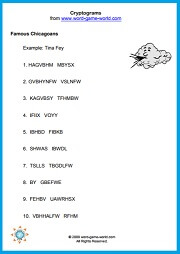
In any type of standard cryptogram puzzle, one letter of the alphabet is substituted with another letter. The same substitution is used throughout a single puzzle.
When you're solving these puzzles, remember that if A = Z, it will always equal Z in that puzzle. But you should not assume that Z = A. It probably does not. Every new puzzle uses a new code.
Remember:
- The most commonly used letter in the English language is E. All the letters of the alphabet in order from most to least frequent are: E, T, A, O, I, N, S, H, R, D, L, U, C, M, P, F, Y, W, G, B, V, K, J, X, Z, Q.
- Usually, the only one-letter words are I or a. (Rarely, o is a word.)
- An apostrophe indicates either a contraction (don’t, I’ll, I’m, it’s) ora possessive noun (Fred’s, the family’s)
And Now for the Tips...

With these facts in mind, here are a few tips on solving cryptograms.
- Always work in pencil, at least until you’re really confident in your abilities.
- Look first at the 1-letter words and the 3-letter words. The 1-letter words are either I or a. The most common 3-letter words are the and and. Other common 3-letter words are not, for, but, are, you, all, can and any. If a 3-letter word follows a comma, it is probably the word and or but. A 3-letter word at the beginning of a sentence is often The.
- Contractions or possessives most often end in n’t or __’s. If two identical letters follow an apostrophe, they are probably the letter L, as in I’ll, we’ll, or they’ll.
- Once you’ve read through the entire passage, make your best guess at some 1-letter, 3-letter words, and words with apostrophes. Pencil in the substitutions for one or two of those words throughout the rest of the selection.
- If the letters you’ve substituted are correct, you’ll see some other words begin to emerge. If nothing looks right, erase and start over.
Here's an Example:
Look at this example of solving cryptograms:
B M Q B ‘ P B M J S Q D B M J L R R Z N J L K X A G F J P.
You see two identical 3-letter words. You guess they might be AND. If you replace all the Bs with As, all the Ms with Ns and all the Js with D, you’ll get:AN _ A’ _ AND _ _ _ AND ……..You think to yourself, what could that first word be????
Then, since you took our advice and used an eraser, you quickly erase those ideas and start over. Now you assume that BMJ is THE.
Now you write:
TH _ T’ _ THE _ _ _ THE …..
which looks much more reasonable. Now you can conclude that Q is A and P is S to spell THAT’S. Then you replace the other Qs and Ps with those letters and you’re well on your way.
Of course, this is a very short example, so you may be hard-pressed to solve this entire sentence. But in case you’re curious… THAT’S THE WAY THE COOKIE CRUMBLES.

Now It's Your Turn!
Put these tips to the test. This set of six short cryptograms is a great place to start!
Be sure to try more from our large assortment of cryptogram puzzles. We have cryptoquotes, cryptograms, cryptofamilies, Bible cryptograms, and weekly cryptograms.
- Word Games ›
- Cryptograms ›
- Solving Cryptograms
Recent Articles


-
Free Word Scramble Games for Any and All Occasions!
 These free word scramble games are a blast to solve! Try our scrambled desserts, movie titles, oxymorons and lots more.
 -
Word Games : Printable Puzzles for Every Age
 Explore printable word games for kids and adults, from crosswords and word searches to original puzzles that make learning and play more fun.


Think-a-Spell
A fun collection of brain teasers and spelling challenges. Best for ages 10 to adult.
101 Word Play Puzzlers
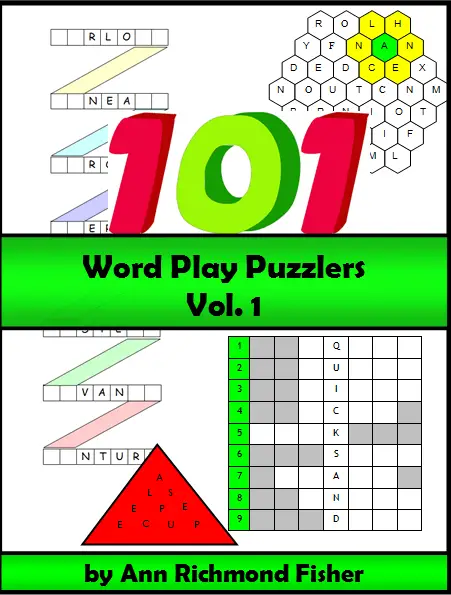
More Buzzwords, Triangulairs, Zigzags and other fun word play puzzlers are packed inside this fun eBook!